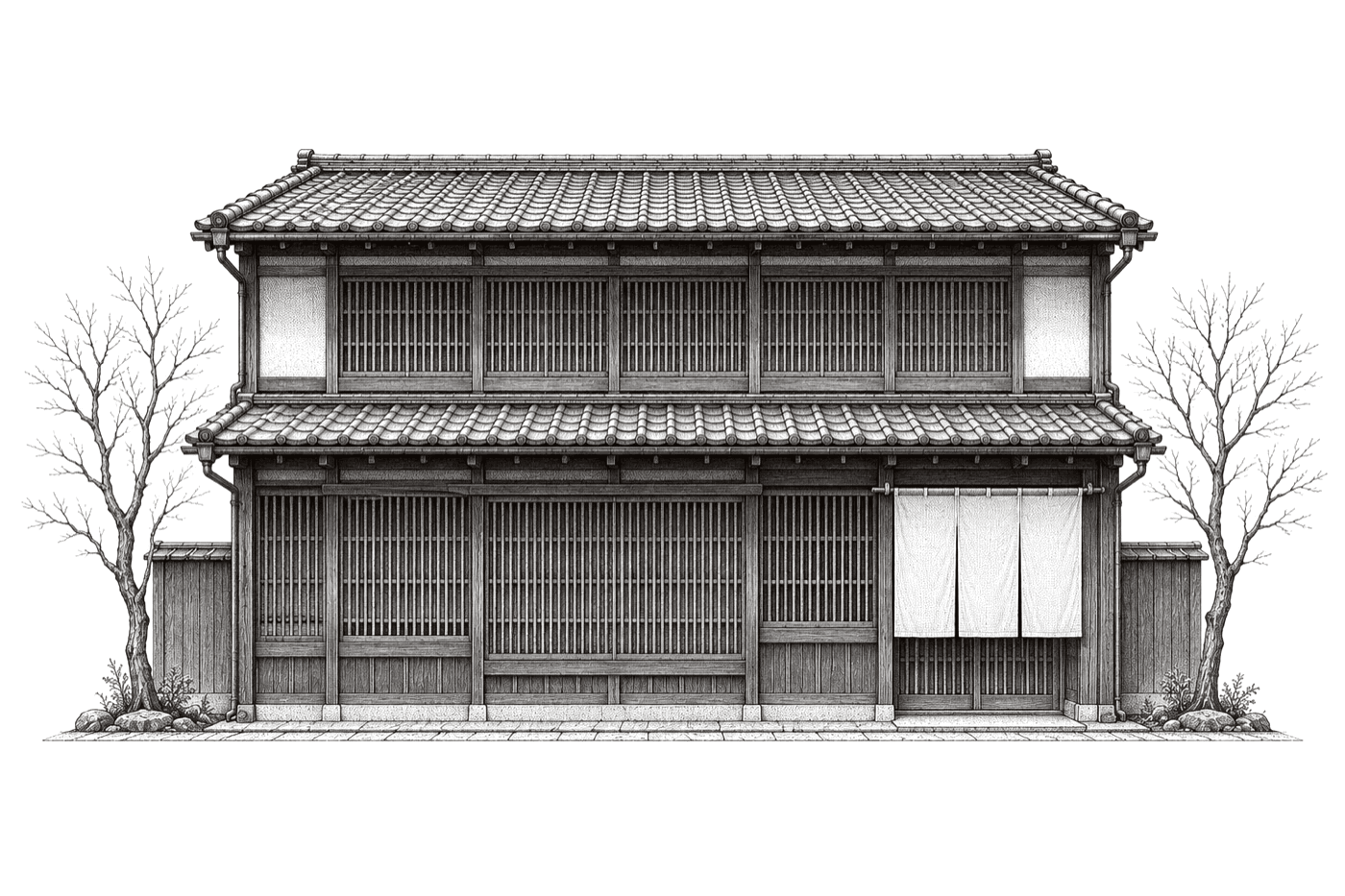
FIG. 05
からくり KARAKURI · AUTOMATON
SECTION
SCALE 1:4

The path / Station 04
[04 / 06] 仕組 SHIKUMI · MECHANISM
Mechanics thatrun by themselves
How smart contracts carry out agreements automatically, and where their limits lie.
From history
A doll that serves tea
In Edo-period Japan, craftsmen build mechanical dolls called karakuri. The best known brings a guest a bowl of tea: it sets off as soon as the bowl is placed on its tray, and stops when the guest picks it up.
Today, programs on the blockchain do the same kind of job. Ethereum opened up these smart contracts to everyone in 2015. And just as Mrs. Watanabe could trade worldwide thanks to the internet, these programs now run all around the globe.
教訓 Lesson
A smart contract does exactly what’s built into it, no more and no less.
Lesson 04.2
Condition, execution, record
A smart contract is a program that lives on the blockchain. It waits for a condition, then carries out an action and records the result permanently.
- [IF]条件JŌKEN
Condition
For example: the payment has arrived and delivery is confirmed.
- [THEN]実行JIKKŌ
Execution
The money goes to the seller automatically, with no middleman.
- [AFTER]記録KIROKU
Record
Everything is on the blockchain and can be checked at any time.
if payment_received and delivery_confirmed
  then transfer(amount, to: seller)
else if deadline_passed
  then transfer(amount, to: buyer)
Experiment
An escrow contract
Ken is buying an old tea bowl from Aiko. Neither knows the other. The smart contract holds the money until delivery is confirmed.
Ready. Ken wants to buy the tea bowl.
Strengths
- [+]AutomaticRuns without a middleman, around the clock.
- [+]TransparentRules and results can be checked by anyone.
- [+]ReliableSame condition, same result, for everyone.
Limits
- [−]Bugs stayA coding error often can’t be fixed once the contract is live.
- [−]Blind to the worldAnything that happens off the blockchain has to be reported by an “oracle”.
- [−]The law is still the lawA smart contract doesn’t replace a contract in the legal sense.
What we offer
Planning Web3 projects strategically
An NFT campaign, tokenising a business model or launching your own token: we’re with you from the idea through tokenomics to launch, with a focus on security and clear communication.
| Topic | Scope | For whom |
|---|---|---|
| [01] | NFT projectsUse case, community, smart contract, minting | Brands, agencies |
| [02] | TokenisationBusiness processes, utility design, tokenomics | Companies, start-ups |
| [03] | Your own tokenChoosing a blockchain, security, distribution | Start-ups, communities |
Do I need to know how to code?
No. To understand smart contracts and use them well, the principle is enough. Experienced developers take care of the build.
Who checks that a contract is secure?
Before launch, the code is tested and reviewed by independent experts (an audit). Every serious project does this.
Is a smart contract legally binding?
Not automatically. It carries out rules technically. We sort out the legal side with lawyers of your choice.
Do you write the code yourselves?
We work with experienced blockchain developers, from simple tokens to complete applications.
Wrap-up
Station 04 complete
You now know how smart contracts work, and where their limits lie.
試験 SHIKEN · Quiz · 3 questions
Three short questions on station 04. Get them all right and the station is complete – then you move on.
[1/3]What does a smart contract do?
[2/3]What happens if there’s a bug in a smart contract’s code?
[3/3]What makes a smart contract useful as an escrow agent?
済
Passed! Station 04 is marked as complete on your path map.
The door is open
Get to know us in a free intro call. We listen, put things in context and show you the next step – without any buy recommendation.
Intro call →